

There is a sentence printed on the back of the most popular flea collar in America, in type small enough that most people never find it.
Wash your hands after handling.
Not "avoid prolonged contact." Not "keep away from open flame." Wash your hands, the way you would after handling raw chicken or spraying the garden, because the active ingredient in that collar is built to cross skin.
That is not a warning bolted onto a safe product by an overcautious lawyer. It is a plain description of how the thing works, and I will show you exactly why in a few minutes.
My daughter sleeps against that dog's neck four nights a week.
I found that sentence on a Tuesday afternoon, standing in a pet store aisle with a box in each hand, and what happened over the following three weeks changed what I put on my animal and why.
But before any of that, I want to tell you the part that made me angry.
Seizures. Tremors. Hair loss down to raw skin. Dogs who stopped eating. Cats who could not walk straight. Owners describing the same sequence over and over, in their own words, in a federal database that anyone could read.
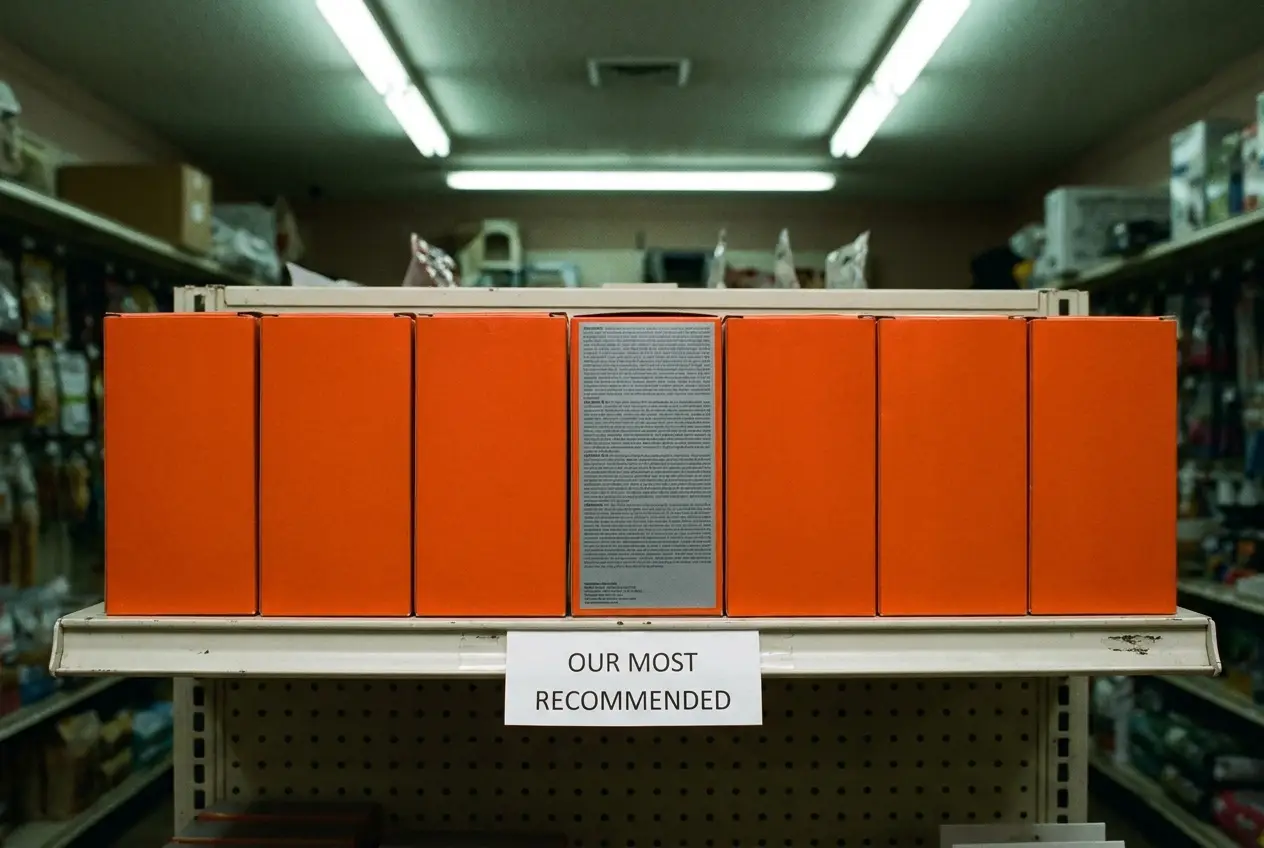
The collar stayed on the shelf. It was still on the shelf that Tuesday, eighteen inches from my left hand, in a bright orange box, underneath a printed sign recommending it.
I want to be careful here, because I am not a scientist and I am not going to tell you that collar killed those animals. Incident reports are reports. That is what the word means. What I will tell you is that a hundred thousand people took the time to file one, that nearly seventeen hundred of them were writing about a dead pet, that national reporters wrote about it, and that the response was a label change.
If a hundred thousand people filed reports about a car, we would not be discussing a label change.
And if you are reading this thinking you have never heard any of this before, that is the part that should bother you most. Neither had I. I had bought that collar twice.
I do not know which version of this you are. Maybe your kids are on the floor with the dog every afternoon, hands buried in his fur and then in their mouths. Maybe your dog lives outdoors, and you pull something off him after every trail. Maybe you have a cat in the house, and you already know what one particular ingredient does to cats, and you have been quietly frightened of getting it wrong.
Different houses. Same aisle. Same two boxes.
I stood in that aisle for twenty minutes and nobody could tell me how either one works
A grown woman in the pet aisle on a Tuesday afternoon, holding a box in each hand, reading them the way you read a contract. Twenty minutes. An employee asked twice if I needed help and I said no both times, because what I needed help with was not something he stocked.
Left hand: the orange box. Effective, widely recommended, and carrying an instruction to wash my hands after touching it. Right hand: the green one. Plant oils, a leaf on the front, no warning at all, which felt like the answer for about ninety seconds. Then I read the reviews on my phone standing right there and found the same sentence written by dozens of different people in dozens of different ways.
It stopped working after about a month.
So there I was. One box that admitted it needed a warning. One box that a hundred strangers told me would quit before summer did. I put them both back and went home with dog food and nothing else.

Over the next two weeks I asked everyone I could think of. My vet, who is a good vet and has kept this dog healthy for six years, told me what she recommends. I asked why and she said it is what works, which is true, and she had four more appointments waiting. I asked in two online groups. Forty replies. Thirty eight of them were product names. Two were people arguing. I asked at the pet store, and the employee told me the popular one is popular.
Every single person answered a question I had not asked.

I kept asking which one is safe. They kept telling me which one to buy. Those are not the same question. Not one person, in two weeks, could tell me how either kind of collar actually works. Everyone had an opinion about the outcome. Nobody had any information about the process. That is when I stopped shopping.
So I stopped asking which one to buy and started asking how they work

It took about an hour to find the answer, which is the part that still annoys me. None of this is hidden. It is simply never the thing anybody leads with.
Both kinds of flea collar are defined by the same thing, and it is not their ingredients. It is their delivery system. How the active material gets from the collar to the place it needs to be in order to do anything at all. That sounds like a technicality. It is the entire product.
You can have the strongest pest deterrent ever formulated and it will do nothing if it cannot reach an insect. You can have a mild one that works beautifully if it reaches the insect steadily for months. Everything about whether a flea collar works, and everything about whether it is safe to have in a house with children in it, comes down to how the material travels.
Nobody sells on delivery. Chemical brands name their actives. Natural brands name their oils. Neither one puts the delivery system on the front of the box, and once I understood why, I could not unsee it. Neither category leads with delivery because in both cases the delivery is the weakest part of the product. One has a delivery system that is dangerous by design. The other has a delivery system that does not last.
Both kinds of collar fail, and they fail for the same reason
I am going to explain both, because once you put them next to each other something obvious falls out that I genuinely did not expect. Neither is hidden. Both designs are printed in plain sight. They are just not the part anybody advertises.
The one that works reaches the flea through your dog's bloodstream
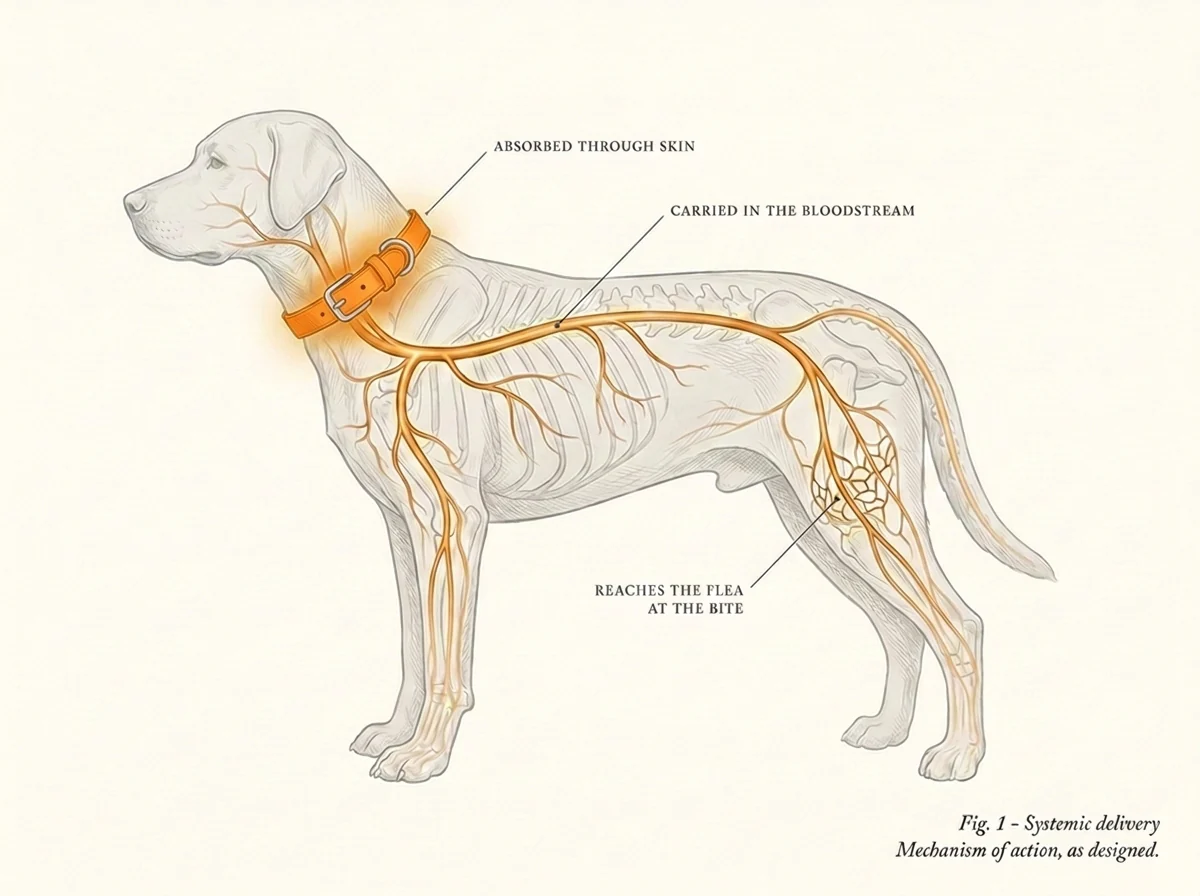
The collar in my left hand works. That is not in dispute and I am not going to pretend otherwise. Here is how.
The active ingredients in a pesticide collar, flumethrin and imidacloprid among them, are designed to be absorbed. They transfer from the band onto the skin, pass through it, and distribute through the animal's body. That is how they reach a flea biting somewhere the collar is not.
Read that again. It took me three tries. The dog is the delivery system. The product does not put a barrier around him. It puts the active ingredient inside him, and the flea encounters it by biting him.
It reaches the flea through his bloodstream. That is not a flaw in the product. That is the product.
And once you know that, the sentence on the back of the box stops being legal boilerplate and becomes a completely logical instruction. Of course it says wash your hands. It is a compound engineered to cross skin. My hands are skin. My daughter's hands are skin. The blanket she drags around the house is not skin, but it spends every evening pressed against a dog wearing a compound engineered to cross skin.
I am not telling you that collar will hurt your dog. I am telling you that a hundred thousand people filed a report, that the design works the way I just described, and that nobody at that store, that clinic or on that packaging thought either fact was worth a conversation.
The one that is safe is empty by week four
So I looked at the green box with fresh eyes, and its problem took about ten minutes to find, because that one is not hidden either.
People have used plants against insects for as long as people have kept animals. Cedar, citronella, lavender. That is not folklore and it is not marketing. Those compounds genuinely deter insects and always have. The failure is not in the plants.
Almost every natural collar on the market is manufactured the same way. A band is made. Then essential oils are applied to the outside of it. Sprayed, dipped, coated. The oils sit on the surface.
Here is the physics, and it is the simplest part of this entire article. Essential oils are volatile. They evaporate readily at ordinary temperatures. That volatility is the entire reason they work as deterrents, because the compounds have to be airborne to affect an insect at all. But when all of the oil is sitting on the outside of a band, all of it is exposed to open air simultaneously. So it leaves. Fast at first, then slower, then it is gone.
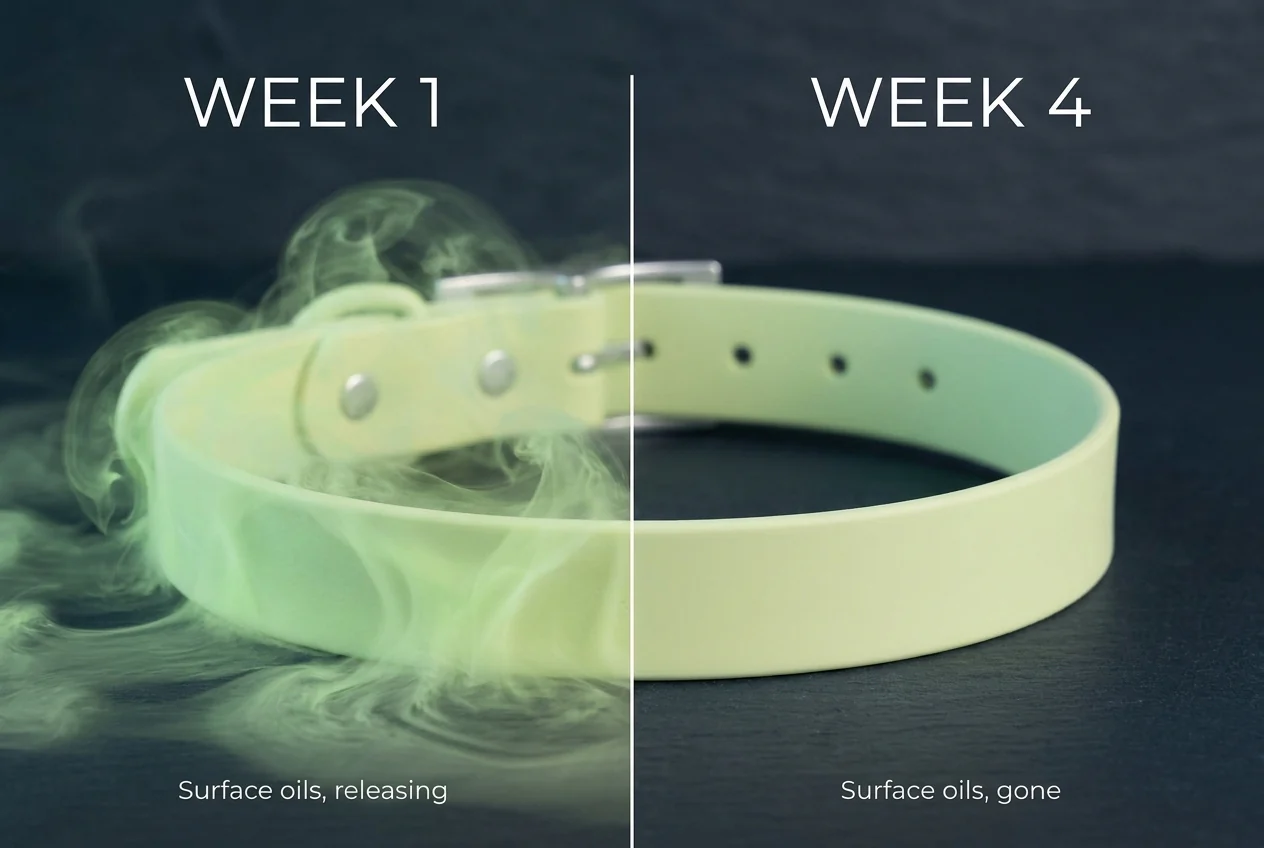
That overwhelming smell in week one, the one that makes you feel like you finally bought something that works? That is the product evaporating. You are smelling it leave. Three to four weeks later there is very little left on the band. The collar is still on your dog. It looks identical. It is finished.
The sprays, the powders and the cedar collars have the same problem

Essential oil sprays work for roughly a day. You reapply constantly and the protection is only as good as your memory. Diatomaceous earth is useful on carpet and in the yard, but worn on an animal it does very little and gets everywhere. Cedar and herbal collars are built exactly like the green box. The four month natural collars are the most honest products in the category, but four months means two a year, and the last stretch is noticeably weaker than the first.
None of them solve the problem. Most of them are the same product in different packaging.
Neither one is a problem with the ingredients. Both are problems with the delivery system. "Safe or effective, pick one" was never a rule about what plants can do. It was a description of the only two delivery systems anyone had built.
There was always a third way to deliver the oils. Nobody built it.
At this point I was not looking at a product. I was looking at a problem with an obvious shape. The pesticide collar delivers too far in. The sprayed collar does not deliver at all after the first few weeks. So the question is not which ingredient is better. The question is whether there is a way to deliver plant oils that avoids both failures at once. Stay outside the animal. Last for months.
Put it that plainly and the answer is not complicated. Do not put the oils on the band. Put them through it.
If the reason surface oils vanish is that all of them are exposed to open air simultaneously, then the fix is structural rather than chemical. Distribute the oils throughout the material itself, so at any given moment only the small fraction nearest the surface can leave. The rest sits held inside. As the outermost portion releases, more migrates slowly outward to replace it, drawn by warmth.
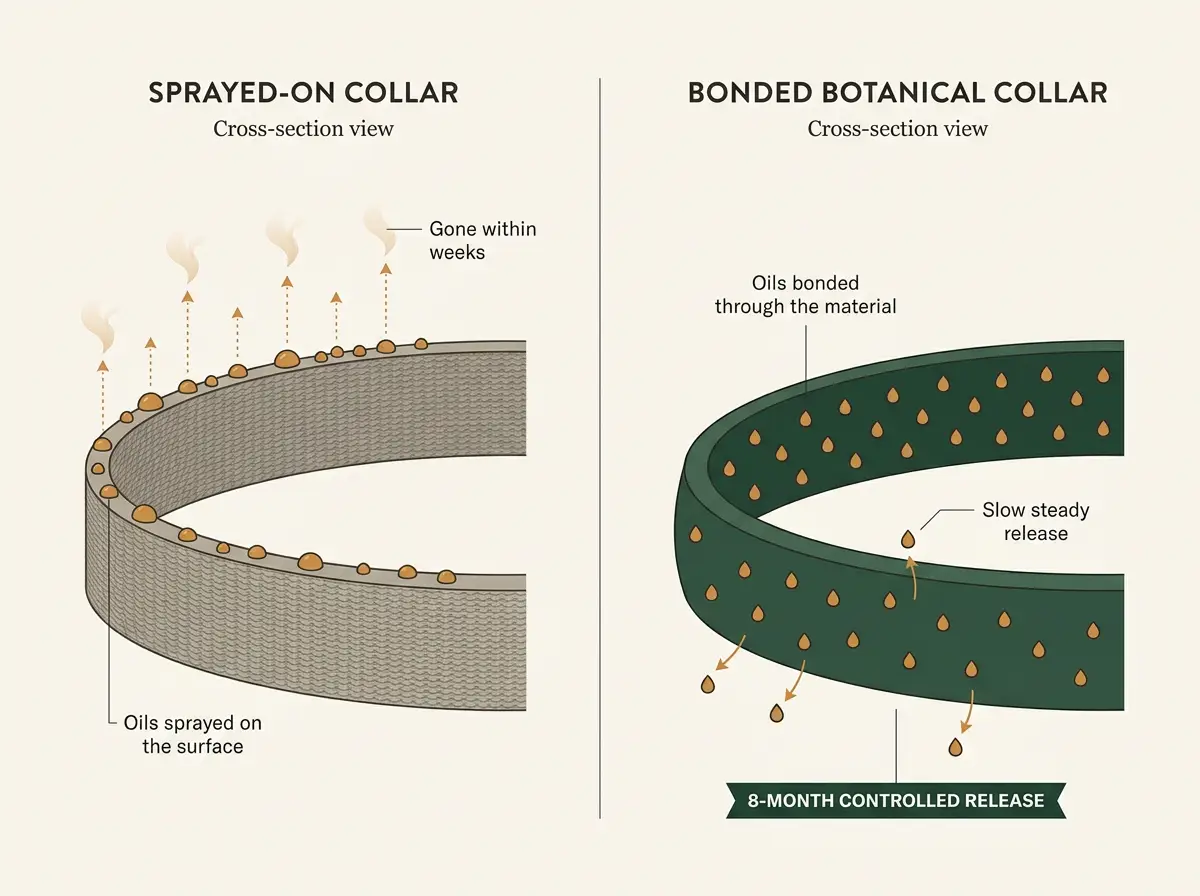
You would get a lower output on day one. It would smell milder out of the packet than a sprayed one does. And you would get a vastly steadier output across months instead of weeks. Nothing would need to be absorbed by the animal, because nothing would be designed to cross skin. The active material would work where it always worked best, in the air immediately around the animal and on the coat, deterring insects before they settle and feed.
That is the third door. Not a stronger oil. Not a better plant. A different way of holding and releasing the ones we already knew worked.
Four problems had to be solved at once. That is why the shelf was empty.

If the idea is that simple, why was nobody selling it? I expected something cynical. It turns out to be engineering, and four separate problems have to be solved simultaneously.
First, the material. You need something that will hold volatile plant oils distributed through its structure for months without degrading. Fabric will not do this. Neither will the cheap plastics used for most collars. Second, the trigger. Something has to draw the oils outward at a steady rate, constant, gentle, never spiking. Body heat is constant, mild and already there. Third, the carrier has to be inert. The entire premise is that nothing synthetic enters the animal, so the material doing the holding cannot itself leach or transfer. Fourth, it has to survive water. Dogs swim. Dogs get bathed. It rains.
Solve one and you have a prototype. Solve all four at once and you have a product. That is genuinely harder and more expensive than making a band and spraying oil on it. Which, as far as I can tell, is the whole answer. Not suppression. A category selling perfectly well without solving a problem that would have cost real money to solve.
This is the same principle as a nicotine patch
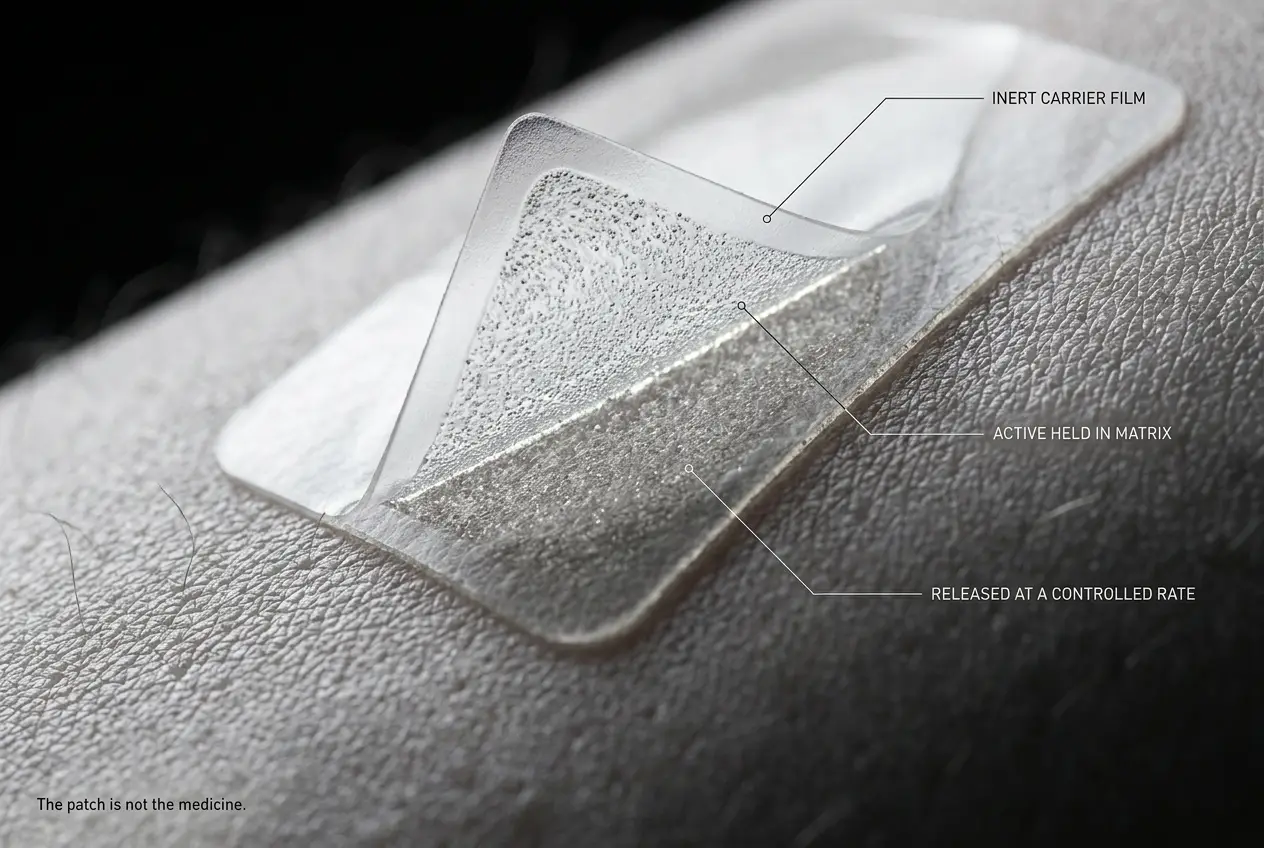
I am not a chemist and I did not evaluate this from first principles. What I did was check whether the idea was real, and it is, because we have been using it on people for decades. A transdermal patch is exactly this mechanism. An active held distributed inside a matrix, released at a controlled, predictable rate. Nicotine patches work this way.
The thing everyone already understands about a patch is the thing that matters here. The patch is not the medicine. The plastic backing is not the medicine. The medicine is held inside, and the design controls how fast it comes out. Nobody worries they are absorbing the patch. The carrier is a carrier.
And most usefully, the failure this predicts is the failure that actually happens. If surface applied oils evaporate at a predictable rate, then sprayed collars should fail at roughly three to four weeks, consistently, across brands, regardless of which plant is used. Go read the reviews of any surface applied natural collar. That is precisely what thousands of people report, year after year.
This is not a new idea. It is a well understood one that nobody had applied to a flea collar, because doing it properly costs more than spraying oil on a strap.
The collar built this way is called Wildroot
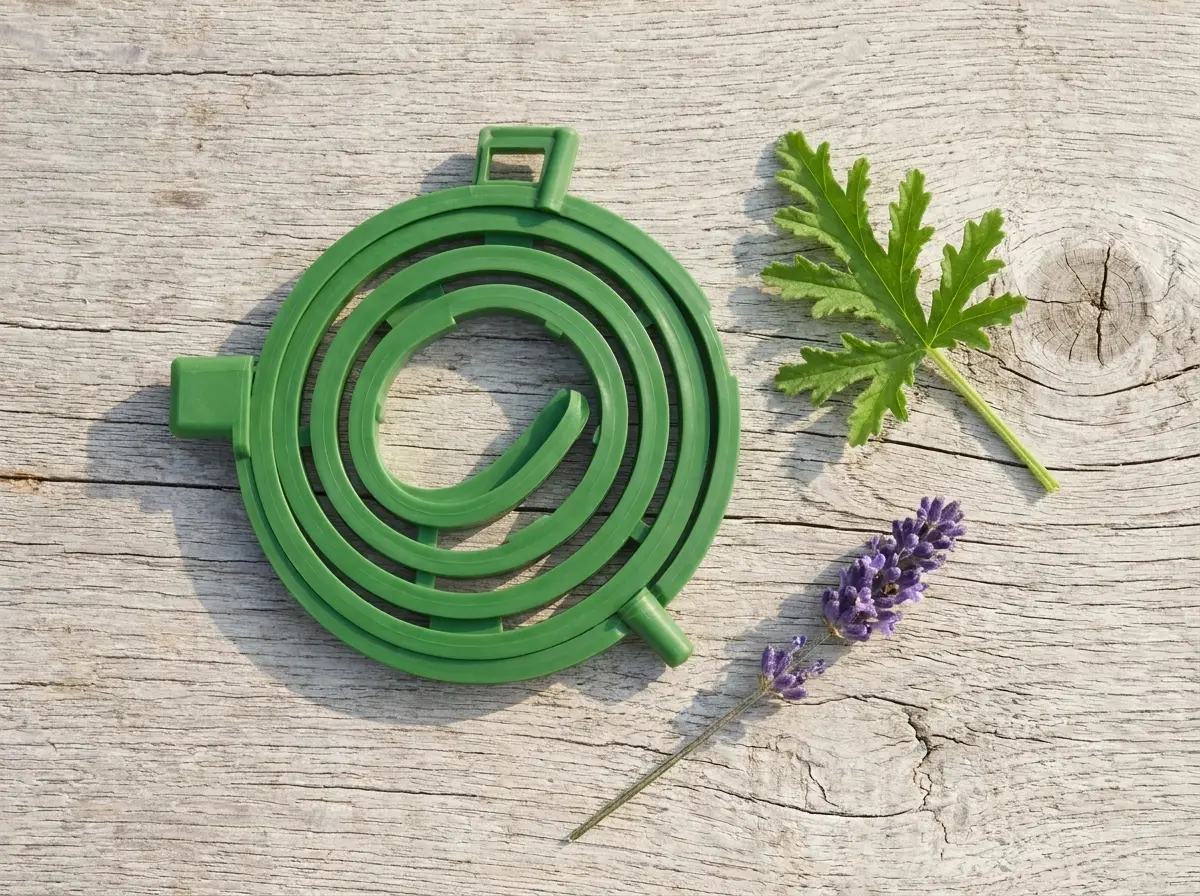
I found it about three weeks into all of this, and the reason I looked twice was not the marketing. It was that they led with the construction. Every other natural collar was telling me their oils were better. Wildroot was the first one describing how the oils are held.
Three plant actives, citronella, lavender and linalool, bonded through a medical grade polymer band rather than applied to the surface of it. Body heat draws them out gradually. Eight months from a single collar. Waterproof. Adjustable, with a safety release buckle. Dog and cat versions, which matters more than it sounds like.
And then the detail that actually decided me, which is a strange thing to say about a negative. They call the band what it is. It is a medical grade polymer. A synthetic material. They say so in writing on their own product page. They do not call it plastic free, they do not call it all natural, they do not use the word silicone. It contains no PVC, no BPA and no synthetic pesticides, and they state that specifically instead of gesturing at it.
After three weeks of reading labels written by people hoping I would not read them closely, a company giving up a marketing word in order to be accurate was worth a second look. This is the one I ended up buying.
What that fixes, specifically
I want to go back to the two failures from that shelf and take them one at a time, because a mechanism is only worth something if it answers the actual problems.
Start with the orange box, the one whose actives are designed to be absorbed. Nothing in this collar works by absorption. There is no step in the design where something needs to cross skin and travel through the animal, because the active material does its work outside him. Which means what comes off the band onto your hands, your children's hands, the couch and the bedding is plant oil. No fipronil. No imidacloprid. No flumethrin. No permethrin, and I will say again that the last one matters twice if there is a cat in your house. That is not a claim about how safe something is. It is a statement about what is and is not in it.
Now the green box, the one empty by week four. The oils here are not sitting on the surface waiting to evaporate. They are distributed through the material, so only the fraction nearest the surface can leave at any moment, and warmth from your dog's body draws more outward slowly to replace it. That is where eight months comes from. Eight months is not the result of a bigger dose. It is the result of a slower release. This collar is not more powerful than the one in the green box. It is more patient.
Volatile compounds move into the air from whatever surface is exposed to it. When oils are applied to the outside of a band, the entire quantity is exposed simultaneously, so output is very high initially and drops sharply as supply runs out. That is the strong first week followed by nothing.
When the oils are distributed through the material, only the portion near the surface can leave at any given time. The remainder migrates outward gradually as warmth draws it. Output is lower on day one and far steadier across months.
The honest trade is worth naming plainly: a bonded collar will never smell as strong out of the packet as a sprayed one. That intense first week is the thing you were paying for over and over.
The same season, three ways
| Pesticide collar | Sprayed natural | Wildroot | |
|---|---|---|---|
| How it works | Absorbs through skin | Surface oils evaporate | Bonded through the band, released by body heat |
| Where it works | Inside the animal | Around the animal, briefly | Around the animal, for months |
| Real working life | Up to 8 months | 3 to 4 weeks | 8 months |
| Collars per 8 months | 1 | 8 or more | 1 |
| Handling warning | Yes | Varies | None |
| Waterproof | Varies | Rarely | Yes |
| Money back trial | No | Varies | 60 days, worn |
Month five is where every other collar had already quit
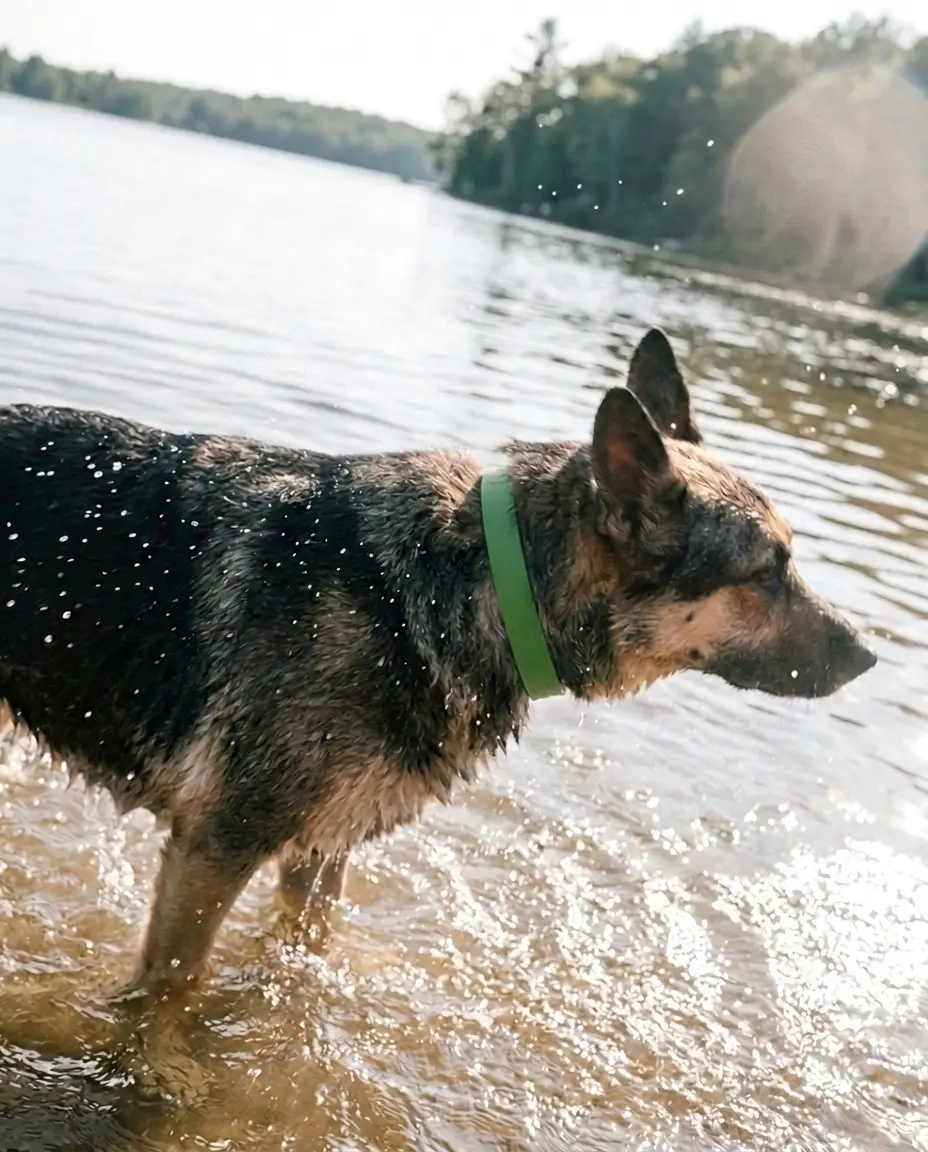
I clipped it on at the end of February, because after everything I had just read I was not going to wait for the first tick to remind me. We are in month five now. Same collar. I am not going to give you a transformation, because that is not what this product does. It subtracts things from your life, and subtraction is quiet.
- No fleas in the house this season. Not one, and last year I found them on the couch in June.
- One tick, in July, pulled off him after a weekend in tall grass. Last year I lost count somewhere around six.
- He has been in a lake most weekends since May and it has changed nothing about the collar.
- It still smells faintly like a garden if I put my face near his neck, which is the exact test every other collar I have owned failed by week four.
And the honest note, because I promised myself I would include it. It never smelled as strong as the green box did on day one. Not close. That bothered me for about a week, until I understood that the smell I was missing was the sound of a product leaving. The thing I notice most is that I stopped thinking about it.
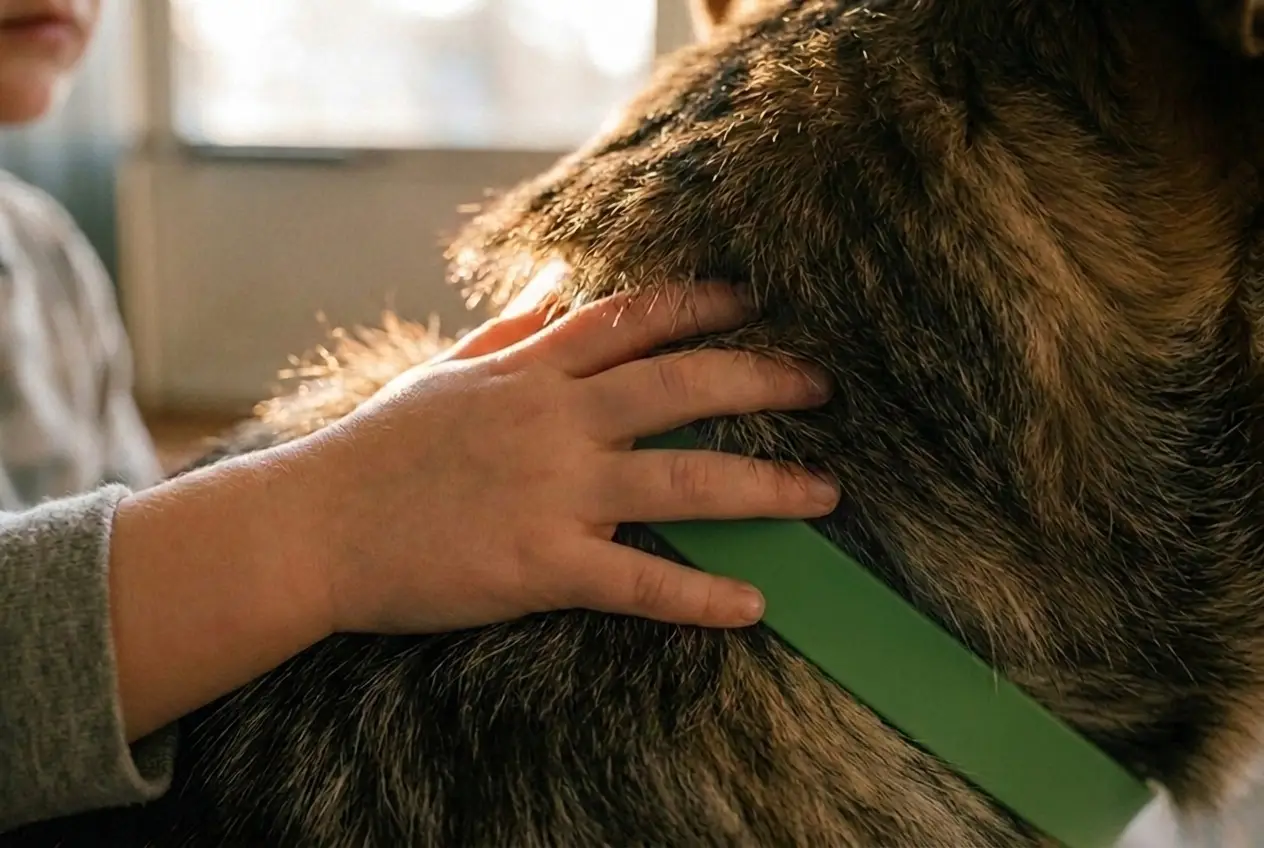
The four questions I had before I bought
1. Can plant based protection actually hold up?
Only if the oils are still there, and that is the whole argument.
The reason natural collars have a bad reputation is not that the plants stopped working. It is that after week three there was almost nothing left on the band to work with. Judge any natural collar by how long the actives remain present and releasing, not by what is on the ingredient list.
2. Is it safe around kids and other animals?
What transfers off the band is plant oil.
There is no fipronil, no imidacloprid, no flumethrin and no permethrin in it, so there is no pesticide residue to move onto hands, bedding or carpet. Wildroot positions it as safe around children and nursing mothers at the concentrations used. That careful phrasing is theirs, and I would rather have it than a bolder sentence with less behind it.
3. Eight months sounds too good. Why should I believe it?
Because it is a release rate claim, not a strength claim.
A collar lasting eight months does not mean it is four times more powerful than one lasting eight weeks. It means the same kind of material is being let out far more slowly. Slower is the entire product, and it is why the smell is milder.
4. What if it does not work on my animal?
Then you send it back, worn, and you get your money back.
Sixty days, and it covers opened and used collars. Nothing else I looked at in either category offered anything close, and that asymmetry is most of why I was willing to try at all.
If your rule is that no synthetic material of any kind touches your animal, this collar will not clear it. The band is a polymer. It is inert, nothing in it is designed to be absorbed, and the company says plainly what it is. But it is not cotton and it is not hemp, and no phrasing changes that.
I decided the material of the container mattered less to me than what the container releases and how long it keeps releasing it. You might weigh that differently, and that is a reasonable place to land.
What other households found

"Two years on these collars and zero fleas or ticks. He lost his last one for a few weeks and I found a tick on him almost immediately. That is the only tick he has ever had."

"Bought it because of the baby, honestly. Kept it because I stopped finding fleas on the cat. Both collars on, both animals fine, no smell in the house."
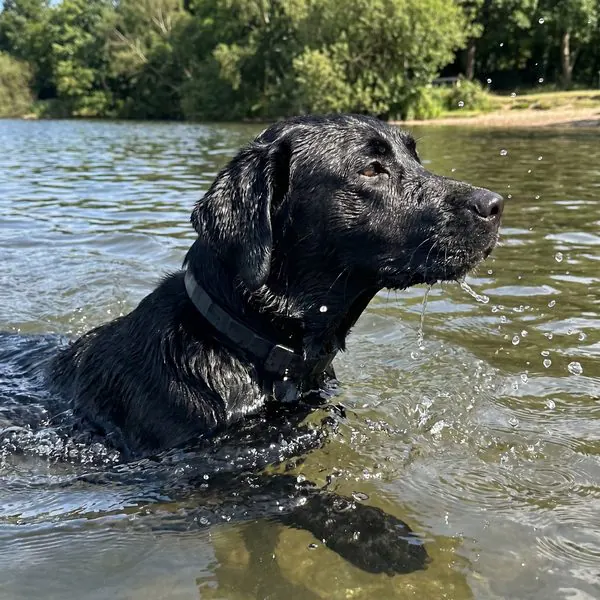
"Third natural collar I have tried. First one still doing something in month five. The other two were done by week four."

"My trail dog is in and out of creeks all summer. First season I have not had to reapply anything or find a tick dug in. It just stays on and keeps working."
Rated 4.5 out of 5 across 143 reviews at time of publication. Individual results vary.
Where to find it
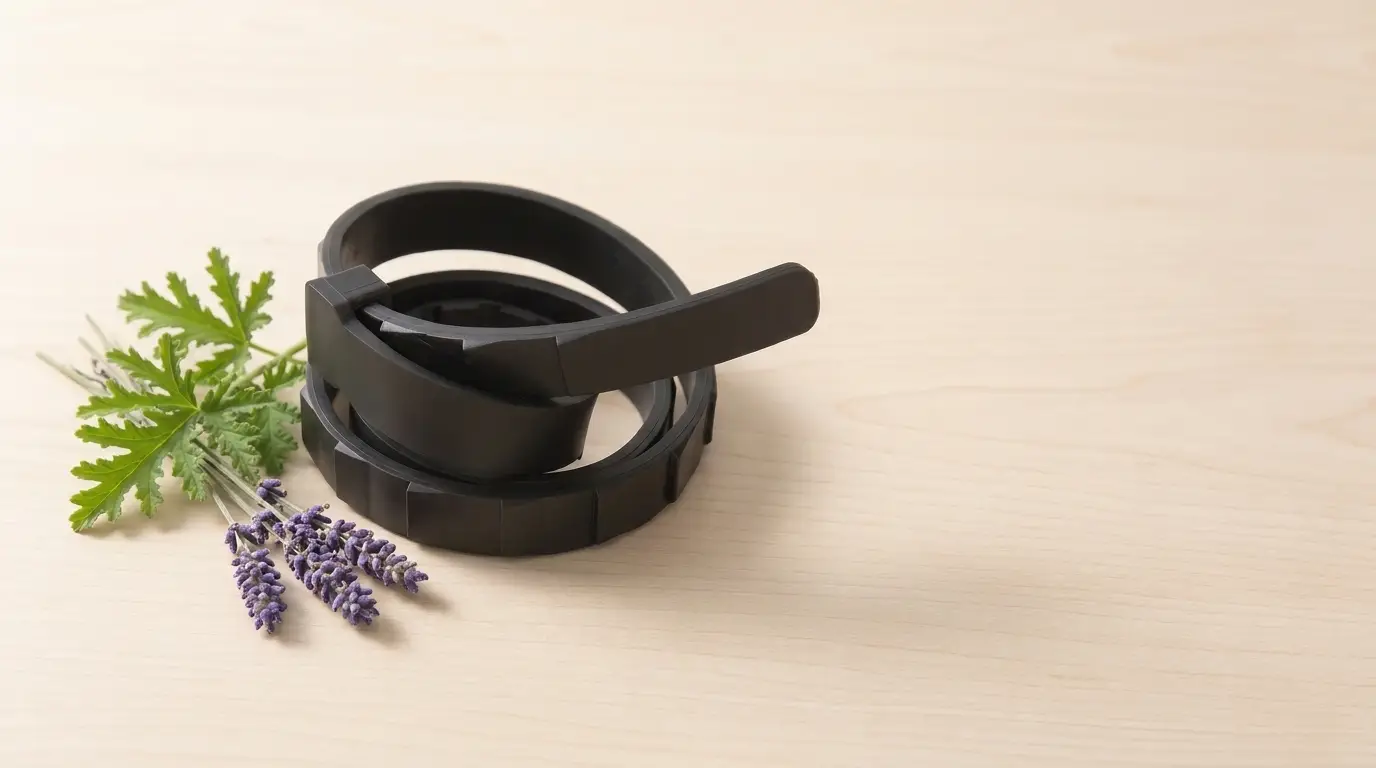
Wildroot Botanical Collar
Sold through Wildroot's own site rather than marketplace listings. Dog and cat versions, with the 60 day money back trial on every order. Stock moves quickly through tick season, so it is worth checking availability before it sells through.
See Wildroot on the Official SiteSixty days is past the point where the others quit
Opened, worn and tested is still refundable
Put it on and watch what happens for two months. Sixty days is well past week three and week four, which is exactly where every surface applied collar in this category gives up. If this one is going to fail the same way, it will fail inside the trial window, in front of you, on your own animal. If you are not satisfied by day 60, send it back opened and worn for a refund. No restocking fee.

What the next eight months look like either way
You are going to live one of these versions regardless of what you decide today. In the first, nothing changes. You go back to that shelf in a few weeks and have the same argument with yourself in front of the same two boxes. That is what my last several years looked like and I did not notice it as a pattern until I added it up.
In the second, you clip something on this week. And then, mostly, nothing happens. You stop checking. You stop pulling things off him after every walk. The kids lie on him and you do not think about the collar, because there is nothing on it that requires thinking about.

Around March you notice it is still working, and that is the point most people I have spoken to said the same thing I did. That it was strange to have quietly solved something that had been bothering them for years.
Tick season is already running
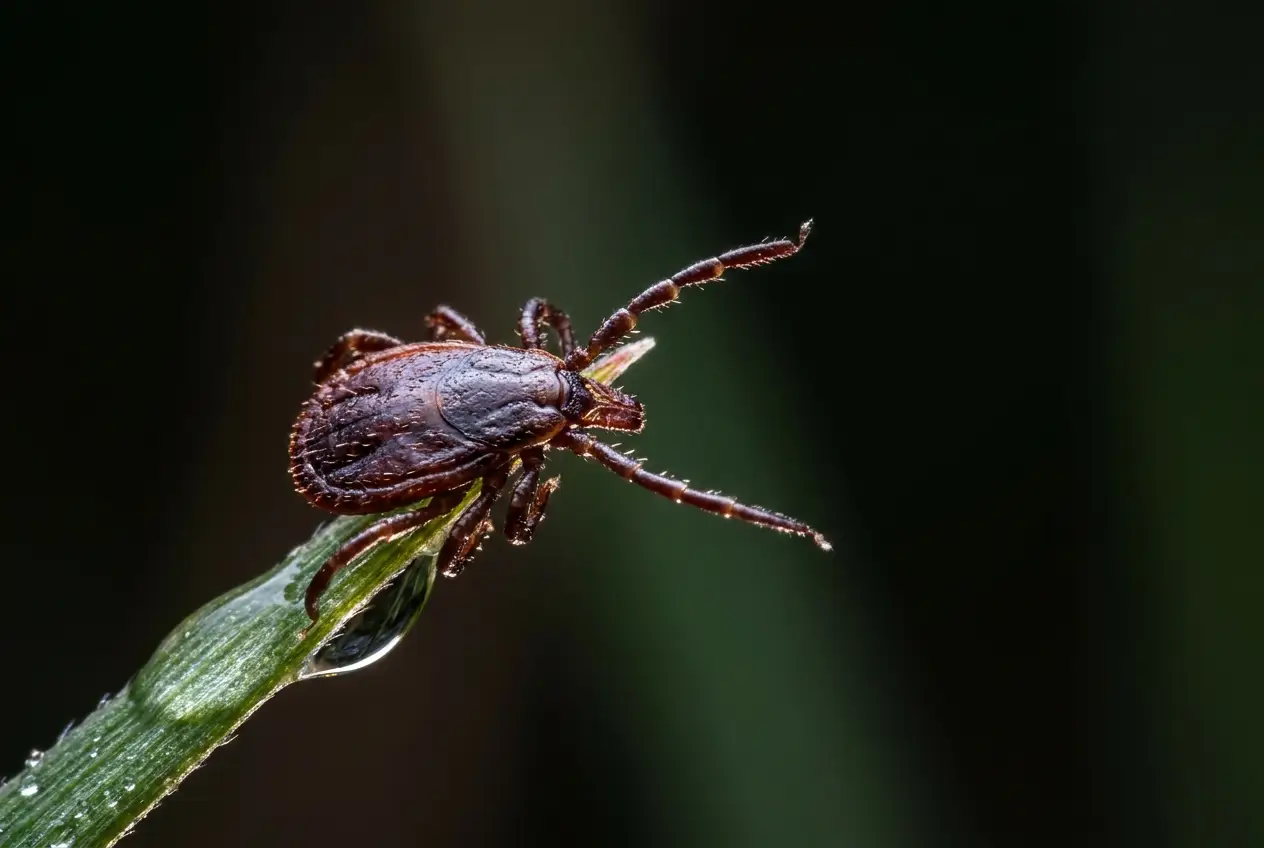
Tick season is underway right now across most of the country and flea populations peak through late summer. A collar you clip on this week covers the rest of this season and carries most of the way through the next one, because eight months from July lands you in March. Wait until the fall and you get the back half of a season out of it.
I still think about that orange box

I think about the twenty minutes, and the employee asking me twice, and how genuinely stuck I felt standing there. And what I understand now is that I was not being indecisive. I was being asked to choose between a product whose design requires it to enter my dog, and a product that would be finished before the summer was, by a category that had never bothered to build a third thing.
Neither of those was a fact of nature. They were both just delivery systems, and delivery systems can be redesigned. Somebody finally did.
You do not have to make that choice either.
Before you buy any natural collar, from anyone, ask the company one question: are the oils sprayed onto the band, or bonded into it? Most will not answer directly. That non-answer is your answer.